The
notion of "écriture féminine" is debatable for some
and undeniable for others. How can there be a kind of
writing rooted on something that only exists as a
social construction? But also: how can it not exist,
for the exact same reasons?
Along comes "Prenez Soin de Vous" ("Take Care of
Yourself" ), a piece by French artist Sophie Calle
(currently at the Bibliotheque Nationale in Paris,
previously at the Venice Bienalle 2007), to give birth
to a new kind of "écriture feminine" : the
"installation feminine." Ultimately an
appropriation of an "écriture masculine" (if we follow
Monique Wittig's logic, perhaps all things female
spring out of the neutral masculine), Calle's piece is
a vindictive extrapolation of sorts. A refusal
to close unresolved wounds. A jab at the
hermetic tactfulness of masculine hubris.
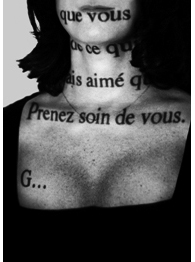
She
took a rupture letter from her boyfriend, in which he
– with a wounding, excessive politeness – skillfully
breaks up with her and she gave it to 107 females from
different professions. The idea was that each
woman would elaborate on the letter, analyze it,
dissect it, decode it, unmask it, translate it --
according to her own métiers and write a letter back
to Sophie with the results.
The results couldn't be more diverse in process (if
not in judgment): from a psychoanalyst's report to a
professional chess player's. Also, Calle's own
mother's assessment, a philosopher's, a translator's,
an actress', a novelist's, a comedian's and even a
clown's.
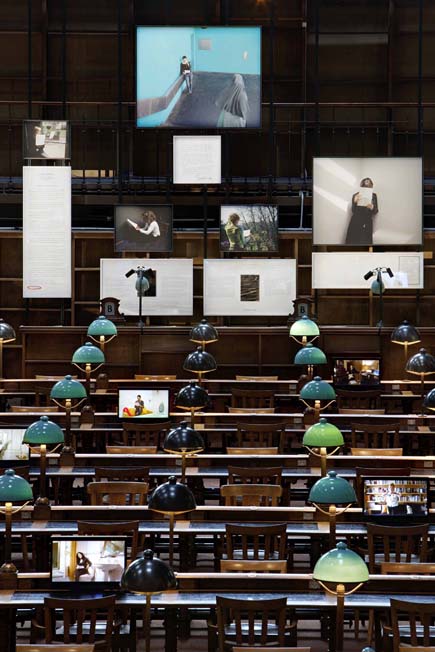
The letters sent back to Calle are exposed in all
their thoroughness around a huge study room completely
dominated by the piece (some last a couple paragraphs,
some are as long as 12 pages). Either in regular
A3-paper form or on huge posters hanging on the walls,
or in video form (less successfully), the responses
tend to sympathize with Calle's suffering and agree on
one thing: the ex boyfriend is a cold, calculating,
talented son of a bitch. What's new?
What
is so moving about the exhibit is its clear potential
for universal identification. Calle has done
what most people have the urge to do when they are
broken up with: we want to know exactly why.
Why? Why? Why? We want the details, we
want "the truth," we want to revisit and dissect the
wound. We want no room left for ambiguity, as if
the details could save us from or even overturn the
verdict!
It is true that, in a way, Calle's process is
anti-psychoanalitical, since other people do the hard
work for her, but that's why this is an art piece, not
a couch session.
Another reason "Prenez Soin de Vous" works so well is
because it immerses you for hours, literally and
literarily, in this tragic love story. In the
end you understand and share Calle's frustrations as
if they were yours. Because they are. Her
ex-boyfriend's words of rupture, in fact, could have
been your own ex's (although likely not as eloquently
put). By the time you leave the room you (a)
realize all love stories are pretty much the same (b)
the feminine counterparts often end up with the short
end of the stick and (c) men suck, and here is the
physical evidence -- 107 of them.